

Large-Scale Gallery Framing: Challenges & Solutions
Nir Hod is a New York-based contemporary artist whose luminous, large-scale paintings hang in major private collections and institutional galleries worldwide.
His work, intricately layered with metallic surfaces, silver leaf, and heavy oil paint, demands custom framing NYC solutions that provide absolute structural stability without pulling focus from the art.
When his gallery prepared a significant body of work for a solo exhibition in Tokyo, Japan, Woodman Frames was commissioned to design, mill, and build the structural framing presentation for the entire collection.
The Challenge: Visual Pacing and Logistics at Scale
Executing large-scale gallery framing projects destined for international transit introduces specific structural, logistical, and aesthetic demands:
Extreme Variance in Scale: The collection comprised a wide range of sizes, spanning from intimate, highly detailed studies to monumental canvases exceeding several feet in each direction.
Exhibition Continuity: The primary challenge was achieving absolute consistency across the entire body of work. When installed together on the gallery walls in Tokyo, every frame had to read as a cohesive, singular series rather than a fragmented collection of individual pieces.
Material Resilience: Large-scale canvases carry significant physical weight and are highly reactive to environmental shifts. Traveling internationally via air or ocean freight subjects organic textiles and wood stretcher bars to rapid fluctuations in humidity and temperature, which can cause warping, corner strain, or joint separation if not properly stabilized.
The Solution: In-House Custom Floater Architecture
To fulfill the gallery specification and the artist's preservation requirements, Woodman Frames bypassed pre-manufactured molding and fabricated a custom tray-style canvas floater profile entirely in-house.
Custom Float Construction
The choice of a float frame configuration was essential for this type of contemporary work. Instead of hiding the edges under a traditional frame lip, the canvas is mounted from behind, sitting slightly forward within the frame structure.
The painted margins and wrapped sides remain fully visible, allowing the artwork to read as a three-dimensional object. The frame securely anchors the heavy stretchers without containing or compressing the canvas surface.
Artisan Material Selection and Profile Engineering
Every single frame was built from scratch at our Long Island City, Queens studio, allowing us to provide the premium framing services NYC galleries and collectors rely on. Our process begins directly with raw, premium domestic hardwoods, ensuring complete structural integrity and artisanal quality from start to finish.
To handle the unique load-bearing requirements of the largest canvases, profiles were milled with deep-set rabbets (the inner recess of the frame) to provide maximum lateral rigidity and prevent bowing over time under the weight of the stretched art.
Bespoke Hand-Finished Lacquer
The clean, minimalist corner frames were finished in a custom white lacquer. This specific tone was developed through a meticulous, collaborative color-matching process with the artist to complement the reflective metallic elements of the paint layers without creating a stark or distracting border.
To ensure a completely uniform texture free of machine lines, the lacquer was mixed in-house and hand-applied across the entire series to produce the standout custom frames that NYC exhibitions require.
The Process: Centralized Workshop Production
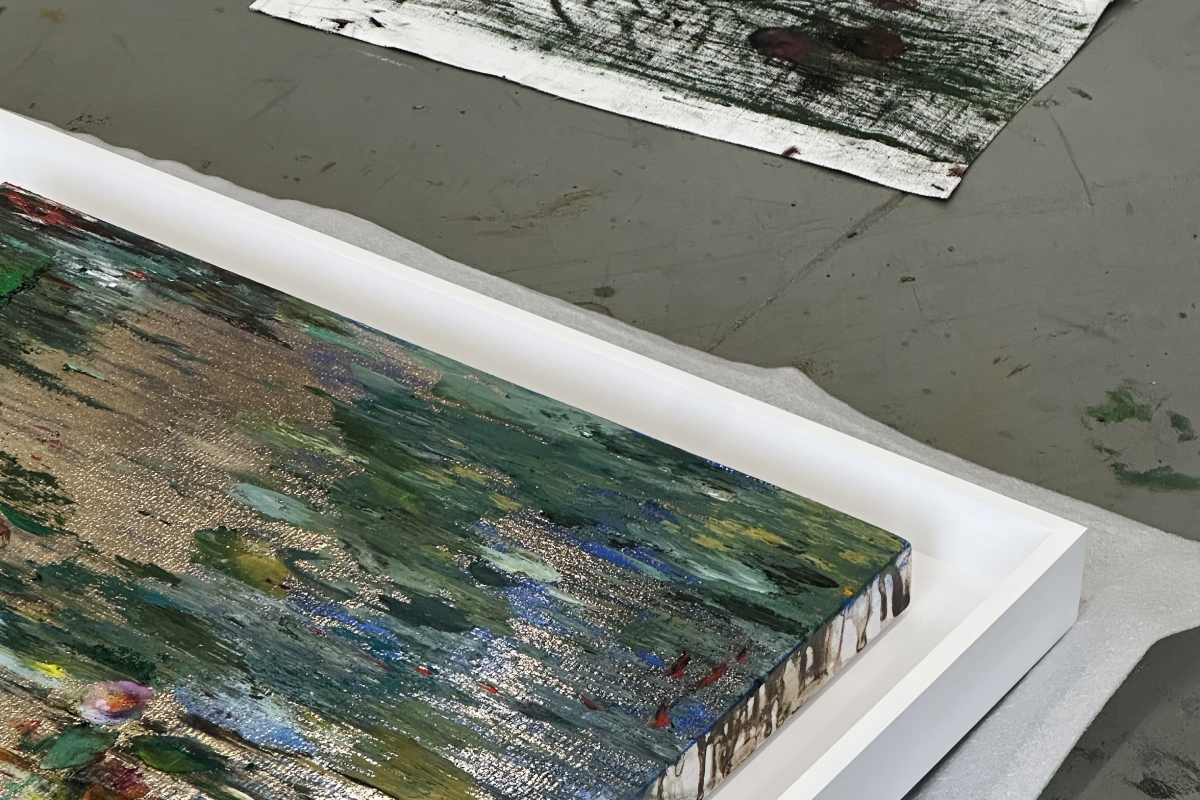
Maintaining perfect uniformity across pieces of vastly different dimensions required a strictly controlled, non-automated workshop pipeline.
True coherence across an entire exhibition comes from building every component under one roof, using matching raw wood lots and the same premium materials throughout.
Our Long Island City team hand-constructed each piece to precise tolerances:
Precision Joinery: Hardwood profiles were cut with exact 45-degree mitered corners and reinforced with hidden spline joints to increase structural bonding area and eliminate corner separation during transit.
Hand-Finished Consistency: Every frame received multiple coats of lacquer, with extensive hand-sanding executed between applications to achieve a smooth, matte gallery finish across every unit.
Archival Alignment: Canvases were centered precisely within the floater trays, establishing a mathematically identical perimeter shadow gap that maintained the same visual rhythm across the entire series.
The Result
The collaboration delivered a complete, exhibition-ready body of work that arrived in Tokyo in immaculate condition. The custom frames effectively insulated the large-scale canvases from the structural stress of international shipping while maintaining their physical and visual integrity.
On the gallery walls, the frames established a powerful architectural pace. Each piece sat securely within an enclosure crafted specifically for it, meeting the exacting standard of a premier international gallery context and fully preserving the artist's original vision.
For professionals who require consistency, expertise, and responsive service, our Trade Partners Program offers a dedicated framing partnership built around your workflow.